
Choosing the Right Inspection Type in Quality Control
When one final check just isn’t enough
Even with the best processes in place, quality issues still happen. A dimension that slips out of tolerance. A label was placed incorrectly. An item may leave the manufacturer in perfect condition but arrive damaged; while small mistakes do happen, they can rapidly snowball into returns, delays, and/or lost confidence in an item.
That’s why quality control today isn’t only about catching defects at the finish line. It’s about reducing risk earlier, when corrections are cheaper, and options are still open. This is where Quality Control Inspection Software plays a practical role—not as a reporting tool, but as a system for making better inspection decisions at the right time.
Lookover is built around this idea: quality doesn’t live in one moment. It moves with your production.
The inspection toolbox is clearly laid out.
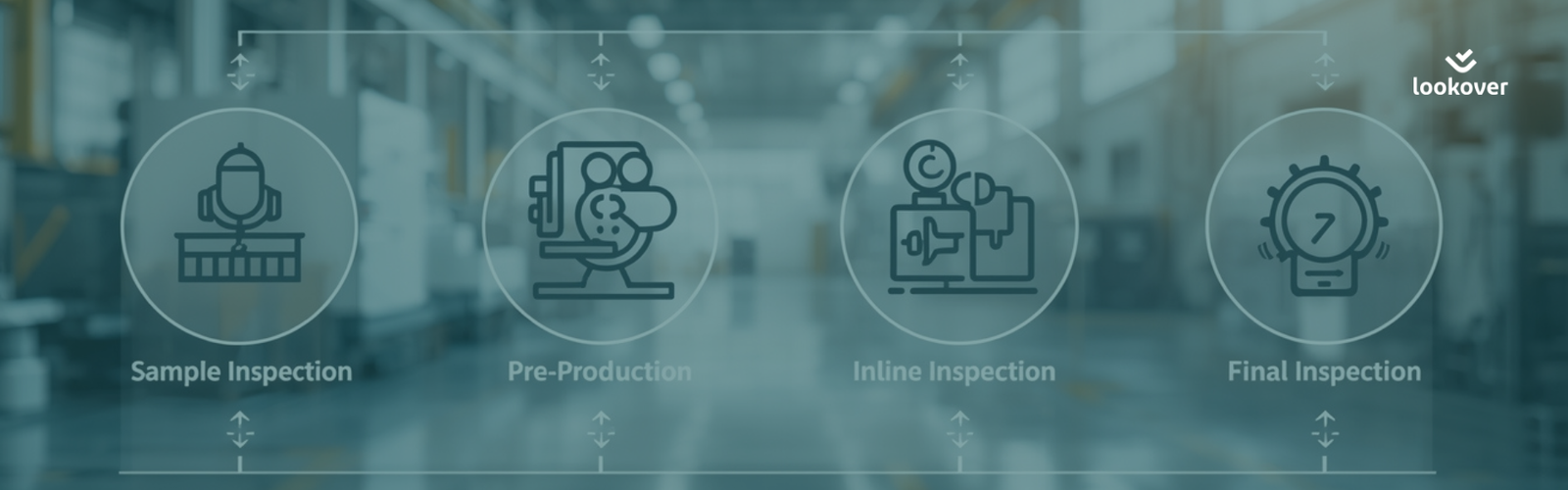
Understanding the different types of inspections will help you know when it is best to conduct an inspection. Lookover has various stages of inspection, with each designed for a particular purpose within the quality lifecycle.
Sample inspections
These are early checks on pilot samples or first-off units. Useful when working with a new supplier, a new product, or a first order. The goal isn’t perfection—it’s alignment. Are materials correct? Are specs interpreted the same way on both sides?
Pre-production inspections
Focused on readiness. Raw materials, tools, setup, and other essesntial component are reviewed prior to the mass production. Detecting issues here stops time from being wasted, scrap, and increases work efficiency.
Inline inspections during production
Performed during production. These inspections monitor consistency and trends, not just individual defects. If quality begins to drift, teams can act before an entire batch is affected.
Final quality control inspections before shipment
The last verification step before shipment. Finished goods are checked against agreed specifications. Final inspections confirm quality—but they shouldn’t be the first place issues appear.
Container loading and warehouse inspections
These inspections, which are frequently disregarded, evaluate the packaging, loading, and final state of an item after transport. This is extremely important for items that can exhibit downstream impacts, whether from having been damaged during handling or mislabelled.
Each inspection type has a role. The value comes from choosing the right one at the right moment!
Quality means different things at different stages
Quality isn’t static. Early in production, it’s about materials and setup. Midway, it’s about consistency. At the end, it’s about conformance.
Some teams focus heavily on final inspection because it feels safer. Others inspect during production but skip early-stage checks. Both ways aren’t bad, but they both have flaws.
This is where quality control software becomes more than a checklist replacement. Lookover centralises product specs, inspection criteria, and findings across stages, so quality expectations don’t change depending on who’s inspecting or when.
The real risk: using the wrong inspection at the wrong time
Final inspections are excellent for verification, but expensive for correction. Inline inspections provide early warnings, but only if data is captured consistently. Pre-production inspections prevent issues entirely—but only if suppliers are ready to be evaluated that early.
Choose the wrong inspection type, and you may be inspecting a lot without actually reducing risk.
The goal isn’t to inspect more. It’s to inspect smarter.
How to decide which inspection you actually need
At Lookover, inspection planning starts with a simple question: what are you trying to prevent—and how early do you want to catch it?
Here’s a practical layout for it:
- Use sample inspections when confidence is low, and alignment matters most.
- Use pre-production inspections when mistakes would be costly to fix later.
- Use inline inspections when consistency matters across large production runs.
- Use final inspections when buyer requirements are strict or shipment windows are tight.
- Use logistics inspections when handling or transporting introduces risk.
Lookover Quality Control Inspection Software supports this decision-making by letting teams schedule inspections, assign them instantly, work offline in the field, and sync results in real time. Data from inspections doesn’t stay in one place; it builds context over time.
From isolated checks to connected quality
One of the strongest advantages of using structured inspection software and compliance management software is traceability. Every inspection is linked to a product, location, inspector, and timestamp—making audits, investigations, and corrective actions easier to manage. Each inspection is linked to a product, location, inspector, and timestamp. When something goes out of order, it doesn’t have to be a guesswork game because teams can trace it back.
With Lookover, you can perform compliance inspections too—by capturing evidence via photo, annotation, GPS, and time-stamped data. To confirm that you are following the appropriate standard, it’s best to refer to Lookover’s compliance documentation or to set up a demo.
Smarter inspections lead to better decisions.
The strongest quality teams aren’t the ones inspecting everything. They’re the ones who understand where quality breaks down and adjust inspections accordingly.
With the right inspection strategy—and the right tools—quality stops being reactive. It becomes predictable. Lookover helps teams move in that direction by turning inspections into a continuous feedback loop, not a last-minute safety net.
And honestly, that’s where quality finally starts to work for you instead of against you.